Yield
YieldA War Week on the Markets: Stocks Broke, Crypto Barely Noticed — What It Means for Your Yield
The US–Iran war crushed Asian markets: KOSPI −9.95% with a trading halt, the Bank of Korea's first hike in 3.5 years, $286M liquidated in a day. Over the same week Bitcoin moved −0.2%, Ethereum rose +4.8%, and safe stablecoin rates kept paying. The old lesson: in a storm, the grade beats the APY.

A war just shook the markets. In the space of one week, South Korea's stock index crashed hard enough to halt trading, the Bank of Korea raised rates for the first time in over three years, and hundreds of millions of dollars in crypto positions were forcibly liquidated in a single day.
We run a site that tracks crypto interest rates and grades every platform for safety, so before writing a word we did what we always do: verified every number against at least two serious sources. Here is the week in checked figures — and what it actually means if you earn interest on crypto. It ends with the oldest lesson in yield.
What actually happened
The trigger is real and serious: the US–Iran war reignited in early July. The ceasefire collapsed around July 7–8, the US struck Iranian targets and blockaded Iran's ports on July 14, and tankers were attacked. Oil spiked. That geopolitical shock is what markets point to.
The damage was concentrated in Asia:
- South Korea's KOSPI fell 9.95% on July 13, triggering a real circuit breaker — a full 20-minute halt of trading. It dropped another 6.37% on July 16.
- The Bank of Korea raised its base rate to 2.75% on July 16, its first hike in over three years, with inflation running at 3.2%.
- SK Hynix, the AI-memory giant, fell about 11.5% on July 16 as investors repriced the entire AI-chip trade.
- China's Shanghai Composite fell 3.05% on July 17, a three-month low.
- The S&P 500 closed down about half a percent; the Nasdaq took the harder hit, around 1.5%.
Serious — but, in the words the sober desks actually use, this is a geopolitical risk-off and a growth scare. Bloomberg's coverage and the IMF's July outlook describe repricing and slowdown, not a systemic banking collapse. The distinction matters, because the space between "serious" and "the end of the world" is exactly where bad financial decisions get made.
What crypto did over the same week
Here is the part that surprised even us when we pulled our own price data. While Korean stocks were halting and chip giants were repricing, the crypto a typical saver actually holds barely moved:
- Bitcoin: −0.2% over the seven days of the sell-off.
- Ethereum: +4.8% — it rose through the week.
- Safe stablecoin rates kept paying — around 5.5% on a B-graded exchange, about 5% on A-graded ones, unchanged by any of it.
And money did not flee crypto — it rushed in. Upbit, Korea's largest exchange, saw its 24-hour volume spike around 1,400%, one of the sharpest jumps on record, as retail rotated out of a halted stock market into something still open.
But the same day brought roughly $286 million in forced liquidations.
That is the entire lesson in one sentence: in a shock, capital pours into crypto, and leverage is what gets destroyed.
Why the boring choice wins in a storm
If you are a saver rather than a trader, a week like this is exactly when the unexciting option quietly outperforms the exciting one.
A stablecoin does not care about circuit breakers. The best safe stablecoin rates right now are modest — but they keep paying whether the KOSPI is green, red, or halted mid-session. That steadiness is the whole point. If you want to see where those rates live today, our stablecoin board ranks every one by safety grade, not just by headline APY.
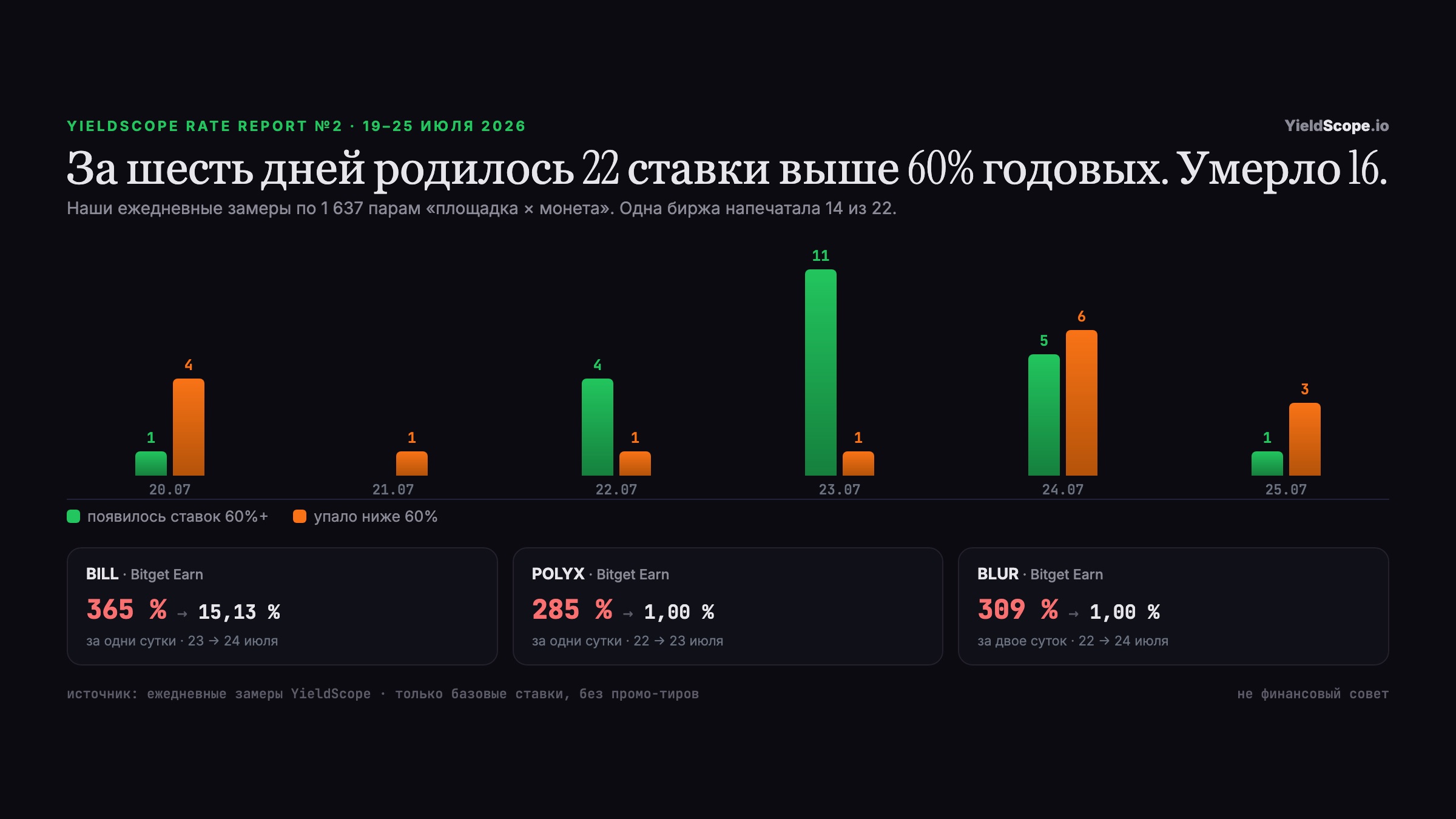
The high-APY trap gets worse in volatility, not better. A "365% APY" on some thin token is not generosity — it is compensation for a drop that is coming. In a market already rattled, that drop is closer, not further. We have written before about how these extreme rates actually behave and why the exchange is usually paying you to hold a falling bag; the mechanics do not change just because the tape is scary. If anything, a storm is the single worst time to reach for them.
No leverage means nothing to liquidate. The $286 million wiped out on Upbit were leveraged positions — bets that borrowed money to amplify a move, and got amplified in the wrong direction. Plain flexible savings cannot be liquidated. They are not exciting. They are simply what survives a week like this one. This is also why counterparty and platform risk matters more than the number on the banner: in a shock, the question is not "how much does it pay" but "will it still be here on Monday."
What to actually do
- Act on facts, not on volume of noise. The war and the Korea sell-off are real; act on them calmly if your plan requires it. Loud feeds are not new information.
- Check the grade, not the headline rate. In a turbulent tape, an A–F safety grade beats a shiny APY every single time. A boring 5% you can trust is worth more than a 365% you have to pray on.
- Keep the boring core in stablecoins on graded venues. Keep any risk small, and keep it un-leveraged.
- This is the week to be a saver, not a hero.
Markets will shake again. They always do. The people who quietly earned a real rate on a safe venue, without leverage, will still be here when the noise fades. That is not a prediction. It is just what has always happened.
Not financial advice. Rates are snapshots and change; markets are volatile. Do your own research.
Educational content, not financial or legal advice. Sources are linked in the text.