Yield
YieldYieldScope Rate Report #2: 22 Rates Crossed 60% APY in Six Days and 16 Died — One Venue Printed 14 of Them
Second issue of our crypto-rate report: between July 19 and 25, 22 rates crossed 60% APY and 16 fell back; BILL on Bitget held 365% for exactly one day before becoming 15.13%; live triple-digit rates grew from 7 to 10. Plus a new metric — how long a rate actually survives: Kraken has not touched its USDT rate in 31 days, Binance changed its own 41 times in 47.
We take a daily snapshot of flexible earn rates across crypto venues, grade every venue A to F on five public safety criteria, and keep the full daily history — currently 1,637 platform × coin pairs. This is the second issue of the YieldScope Rate Report. As with the first, every number below is checkable on the site.
The week of July 19–25 produced three stories: a triple-digit rate conveyor that barely took a day off, several collapses that fit inside twenty-four hours, and a new metric we started publishing on every page this week — how long a rate actually survives.
22 born, 16 died — in six days
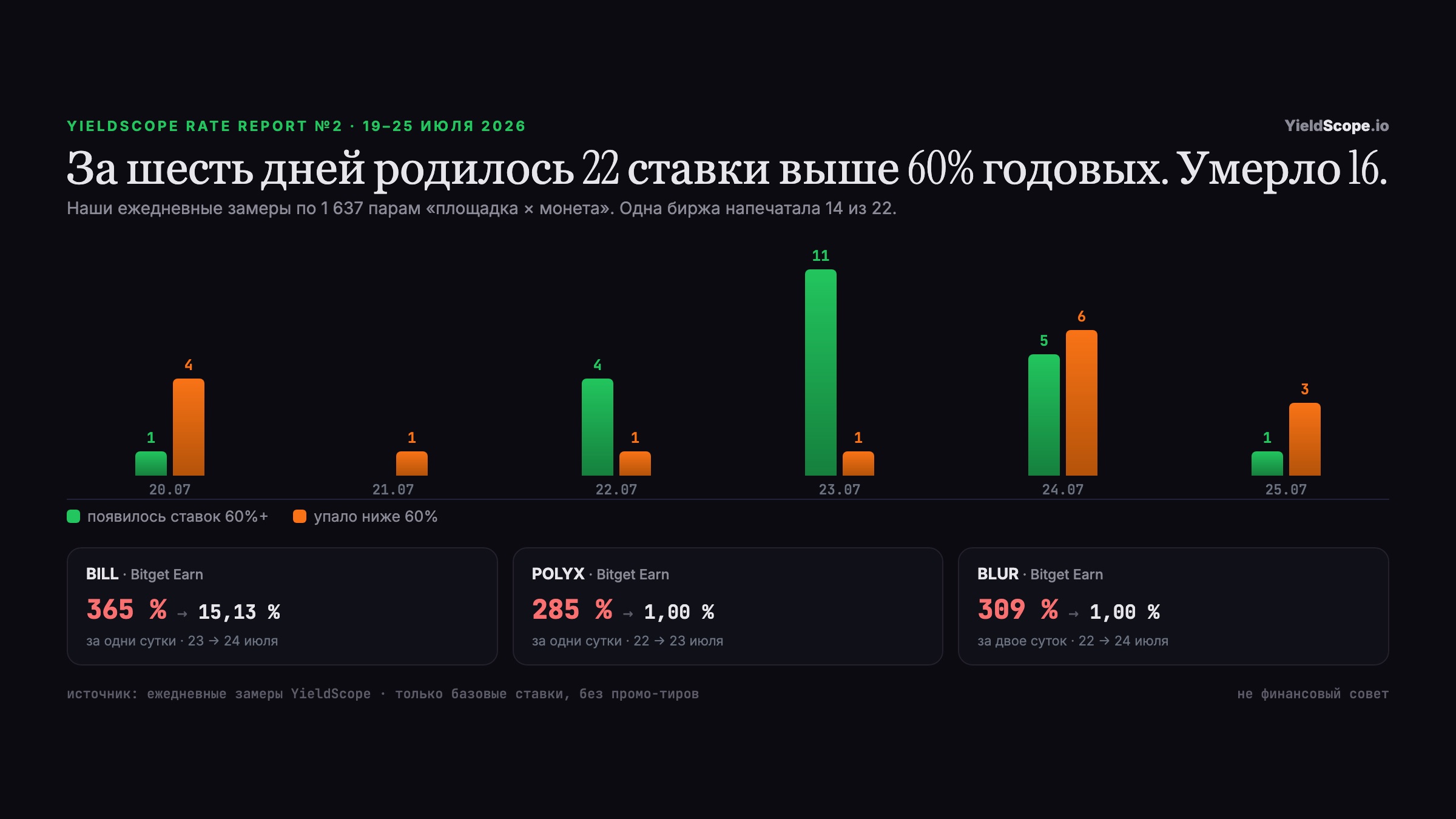
Between July 19 and 25, 22 rates crossed the 60% APY threshold and 16 fell back below it. Day by day:
● July 20 — 1 born, 4 died ● July 21 — 0 born, 1 died ● July 22 — 4 born, 1 died ● July 23 — 11 born, 1 died ● July 24 — 5 born, 6 died ● July 25 — 1 born, 3 died
The July 23 burst — eleven new rates above 60% in a single day — is not the market moving. It is one venue refreshing its promo grid.
The split by venue leaves little room for interpretation:
● Bitget Earn — 14 of 22 ● OKX Earn — 5 of 22 ● Bybit Earn — 3 of 22
The other thirty-plus venues we track printed no rate above 60% at all that week.
Collapse speed: one day
Three cases from the week, all on Bitget, all verifiable against our history:
● BILL — 365% on July 23, 15.13% on July 24. Exactly one day on the shelf ● POLYX — 285% on July 22, 1.00% on July 23. Also one day, a 285-fold drop ● BLUR — 309% on July 22, 1.00% on July 24. Two days
This is the mechanism we described in our 60-day report: the median lifespan of a 60%+ rate is one day. The week of July 19–25 confirmed it again, without exceptions.
The practical takeaway is simple. Between the moment you see a screenshot with a triple-digit number and the moment your money actually lands after registration and identity checks, the rate has most likely changed. The promo pool is spoken for by then.
The new metric: how long a rate holds
Since yesterday, every platform × coin page shows not just the rate but its track record: how many days the current number has held, and how many times the venue changed it over the period we have recorded.
The first cut, on USDT flexible savings — withdraw anytime, so the comparison is like for like — looks like this:
● OKX — 2.50%, unchanged for 49 days ● Crypto.com — 0.50%, unchanged for 34 days ● Kraken — 5.50%, unchanged for 31 days ● Nexo — 5.50%, unchanged for 31 days ● WhiteBIT — 1.94%, unchanged for 31 days
And the other side:
● Binance — 1.53%, changed 41 times in 47 days ● Gate.io — 1.44%, changed 31 times in 37 days ● Bitfinex — 9.12%, changed 20 times in 35 days ● KuCoin — 0.91%, changed 19 times in 35 days
Two numbers worth putting side by side: Kraken pays 3.6 times more on USDT than Binance does, and has not touched the number in a month. The largest exchange in the world rewrote its own almost every morning.
Bitfinex deserves a separate note: 9.12% is the highest rate in the unstable half, on a D-graded venue that moved it twenty times in thirty-five days. A high rate that gets rewritten weekly is not income. It is a guess.
More triple-digit rates than a week ago
In the first issue we counted 7 live rates above 100% APY. There are now 10:
● VELVET — 365%, Bitget ● RIF — 365%, Bitget ● RE — 365%, Bitget ● GWEI — 365%, Bitget ● O — 276%, Bitget ● BARD — 207%, OKX ● BARD — 150%, Bybit ● DATA — 120%, Bitget ● GENIUS — 102%, Bitget ● BARD — 100%, Bitget
An honest caveat is due here, and we would rather make it ourselves. Eight of those ten sit on Bitget — the venue holding our top grade of A. There is no contradiction, but there is a distinction worth understanding: our A–F grade measures the risk of a venue as a custodian of money — licensing, proof of reserves, insurance fund, withdrawal flexibility, incident record. It does not measure how durable the individual rates on the shelf are. A venue can hold your money conscientiously and still print promo numbers that live for a day. Those are two different properties, and we now show both.
What is not in this issue
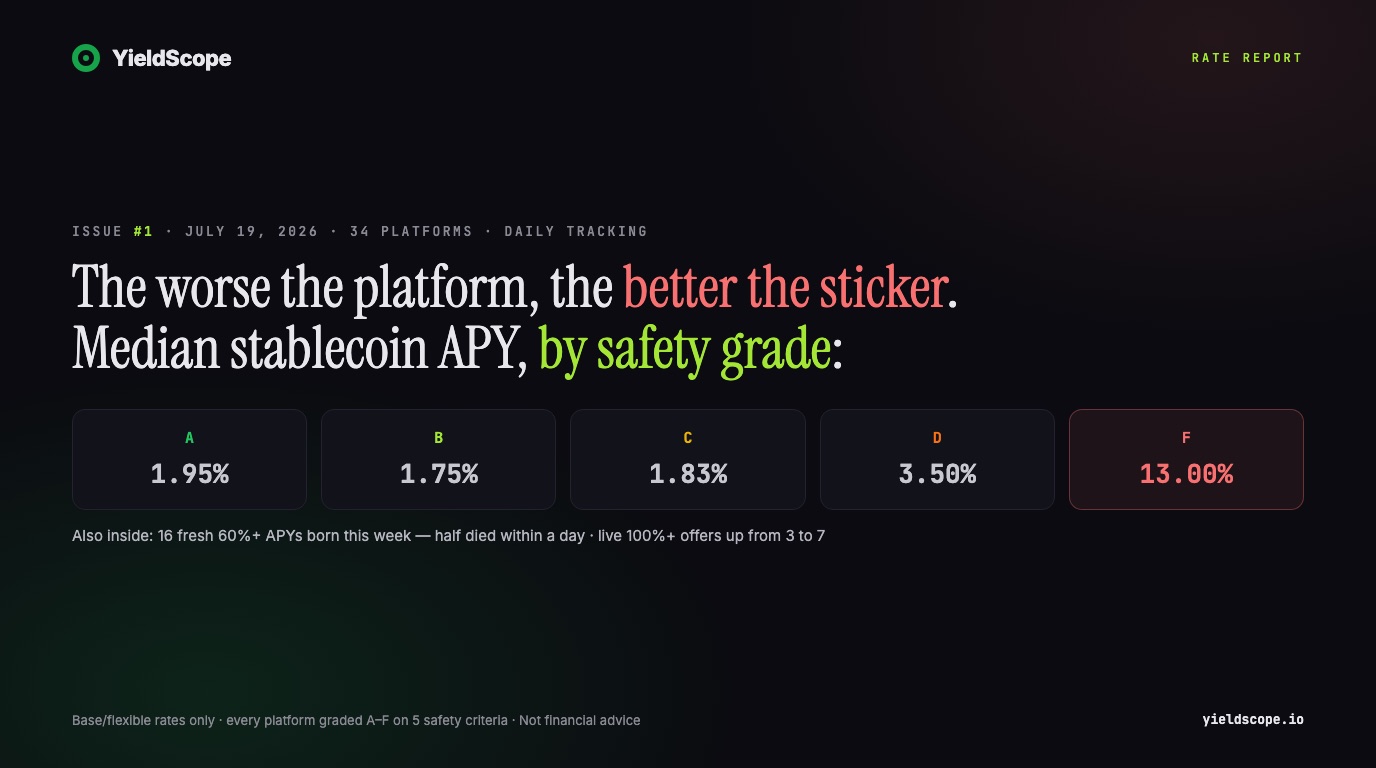
In the first issue we published the median stablecoin rate by grade — 13% on F-graded venues against 1.95% on A-graded ones. We are not publishing it this time, and here is why: as of today exactly one venue in our sample holds an A grade. Computing a "median across A-graded platforms" from a single platform means dressing a special case as a statistic. We will bring the number back when the A group has enough venues for a median to mean anything.
What changed since the last issue
The first issue covered July 12–19; this one covers July 19–25. Comparing the metrics we count the same way:
● New 60%+ rates: 16 → 22 ● Live rates above 100%: 7 → 10 ● The printer's share of new spikes: roughly half for Bitget → 14 of 22, close to two thirds ● Fastest fall of the week: 365% → 15.1% in a day (DATA) → 285% → 1.00% in a day (POLYX)
The direction is unambiguous: the promo conveyor did not slow down over the week, it sped up, and concentration tightened — nearly two thirds of every triple-digit promise on the market now comes from a single venue.
Which makes the other half of the picture more valuable. Over those same six days Kraken's USDT rate did not move once, just as it had not moved for the twenty-five days before. The yield market is two layers that barely touch, and the noise of one says nothing about the other.
Method
All figures come from our own daily rate snapshots, with no third-party aggregators involved. We record base rates: what an ordinary depositor gets, not the promo tier with a token boost and a lock-up in the footnote. "A 60%+ rate was born" means a crossing of the threshold between two consecutive snapshots; "died" means the reverse crossing. The USDT comparison is limited to flexible products with anytime withdrawal, so a one-month lock is never compared against daily access.
The live board with every venue and grade is on the home page. The grading methodology is published and reproducible: how we score risk.
This is not financial advice.
Educational content, not financial or legal advice. Sources are linked in the text.