Yield
YieldThe rate on the poster is not the rate on your money
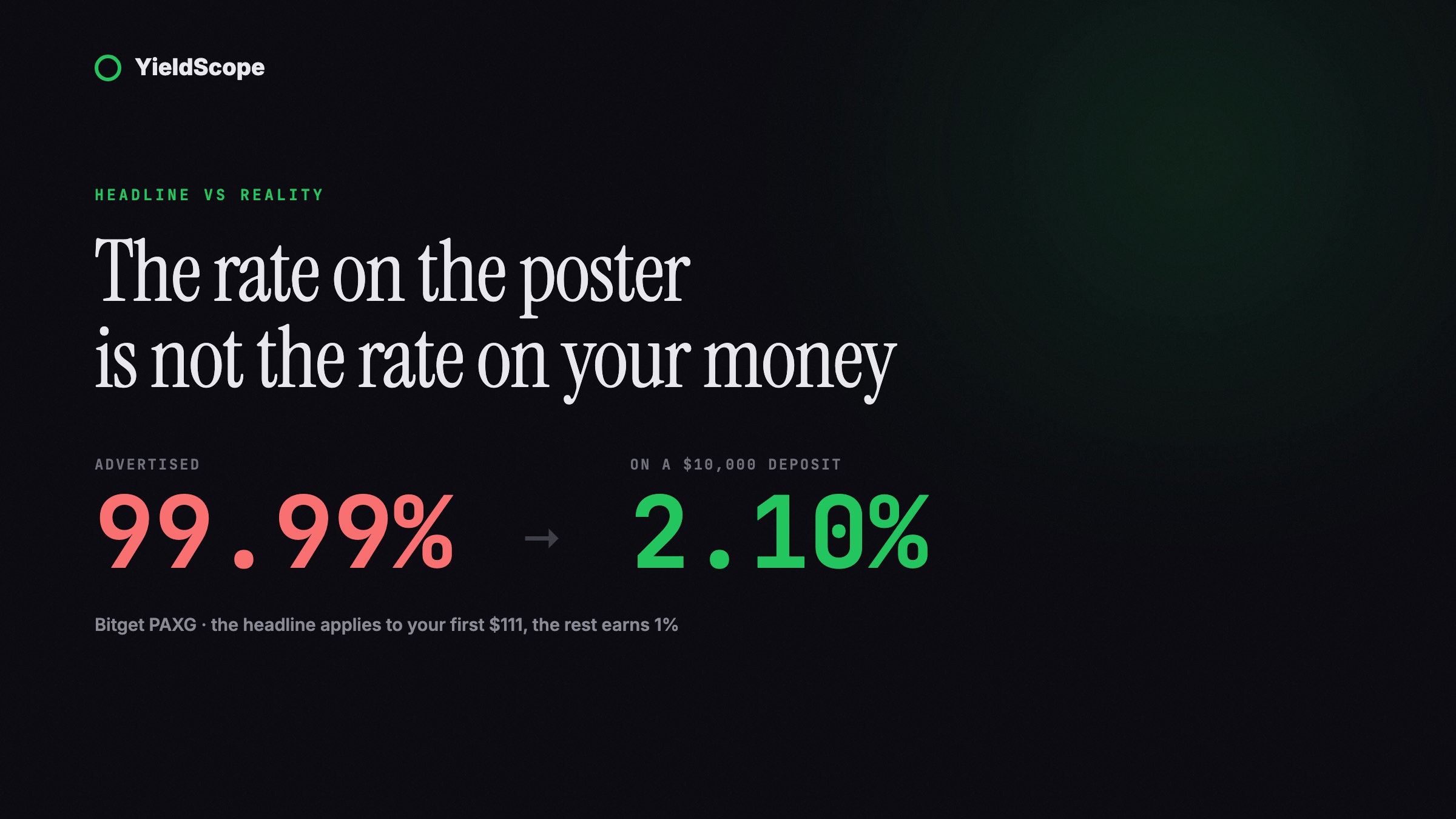
Nine of the 77 savings accounts we track pay effectively nothing by default — while advertising up to 5.85%. Crypto exchanges run the same trick through size: Bitget's 99.99% applies to your first $111 and turns into 2.10% on a $10,000 deposit. What the gap looks like, and how to read a headline in ten seconds.
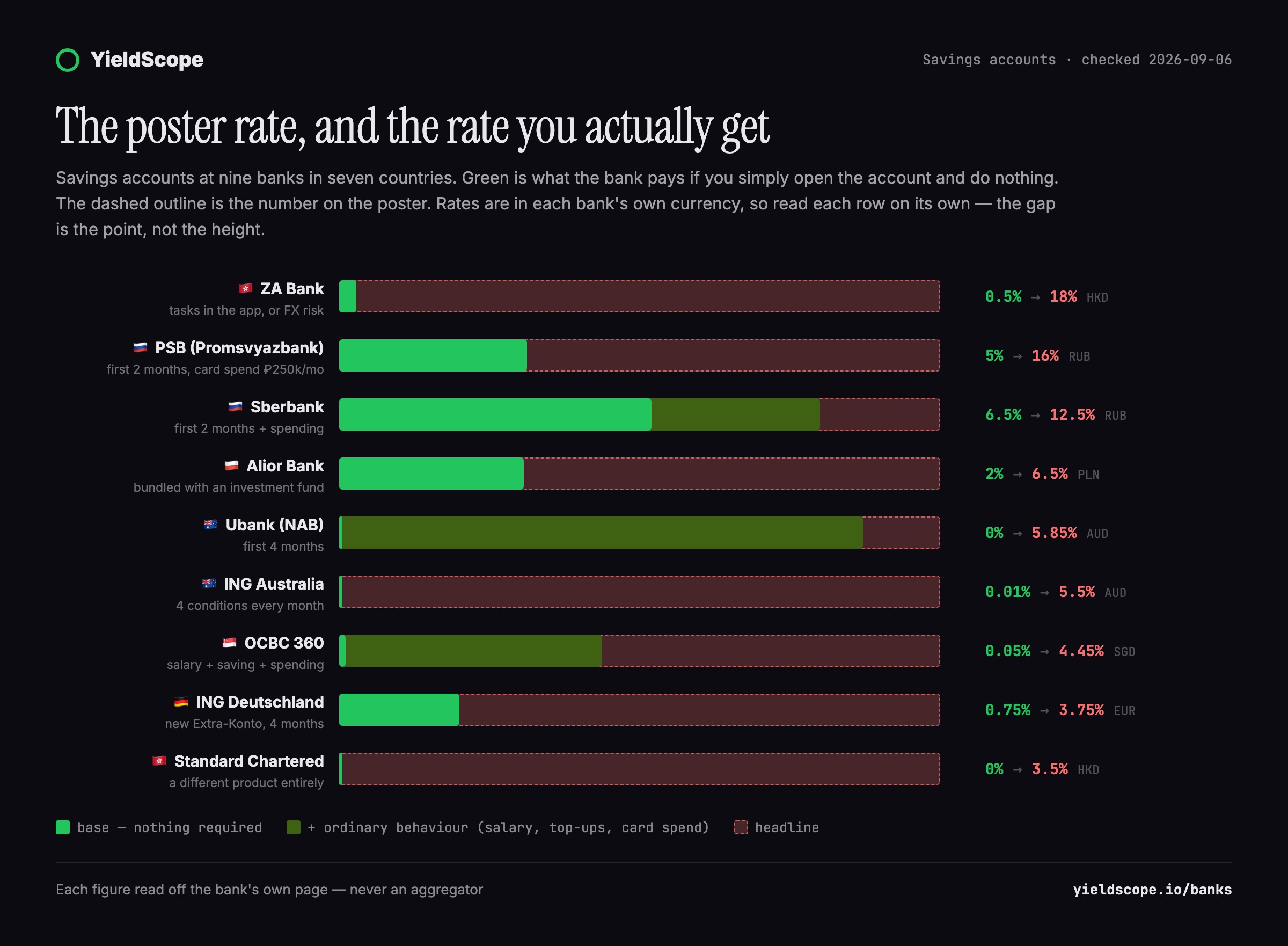
Nine banks in our data pay effectively nothing if you simply open the account and leave money there. One of them advertises 5.85%. Another advertises 5.5% while paying 0.01% by default. This is not a scandal — it is the standard design of a savings product, and crypto exchanges have copied it exactly.
Open the website of almost any bank and you will find a single large number. Five point eight five percent. Four point four five. Eighteen. It sits in the hero block, in the tab title, in the advertisement that followed you here.
That number is real. It is also, for most people who open the account, unreachable.
We have spent the past months writing down three numbers for every savings account we track instead of one, and the gap between them is the most consistent finding in the whole dataset.
Three numbers, not one
For each bank we record:
- Base rate — what the money earns if you open the account and do nothing else. No salary transfer, no monthly spending target, no subscription.
- Realistic rate — the base plus whatever you get for ordinary behaviour: your salary landing in the account, regular top-ups, normal card spending.
- Headline rate — the number on the poster, with every condition satisfied at once.
The headline is not a lie. It is a ceiling, and reaching it usually requires a specific combination of behaviours that most account holders will not maintain for twelve months.
Across 77 savings accounts in 19 countries, 43 advertise a headline above their own base rate. The median base is 2.75%. The median headline is 4.00%.
What the gap actually looks like
The chart above reads one row at a time. Rates are in each bank's own currency, so comparing the heights across rows tells you nothing — 18% in Hong Kong dollars and 16% in roubles are not competing offers. The gap inside each row is the point.
Some specifics from the data:
- ING Australia advertises 5.5%. The default rate is 0.01%. To get the advertised figure you must satisfy four separate conditions every single month — deposit a set amount, make a set number of card purchases, grow your balance, and hold the linked everyday account. Miss one, and that month pays the default.
- Ubank (NAB) advertises 5.85% and pays 0% by default. The advertised rate is an introductory offer for the first four months.
- Standard Chartered Hong Kong advertises 3.5% and pays 0% on the savings account. The 3.5% belongs to a different product entirely.
- ZA Bank advertises 18% against a base of 0.5%. Getting there means completing gamified tasks in the app, catching a promotion, or accepting currency risk on a foreign-currency deposit.
- Alior Bank advertises 6.5% against a base of 2%. The higher rate is only available bundled with an investment fund purchase, which means part of your money stops being a deposit at all.
There is a second, quieter finding. At 53 of the 77 banks, the realistic rate equals the base rate exactly. Ordinary behaviour — getting paid into the account, spending on the card, topping up each month — buys you nothing at all. The conditions attached to the headline are not "behave normally"; they are "behave in this specific way, or buy this specific other product".
Why the currency matters more than the number
Turkey is worth a paragraph on its own. Enpara.com advertises 37% and pays 27% by default, which by the standards of this article is remarkably honest — the base is three quarters of the headline.
But both numbers are in lira. A high nominal rate in a currency losing value to inflation is not generosity; it is compensation. The real return can be zero or negative. This is why we never rank banks across currencies by rate alone, and why the chart above asks you to read each row on its own.
Crypto exchanges do the same thing, differently
Banks gate the headline behind behaviour. Exchanges gate it behind size.
The mechanic is a tiered ladder: the advertised rate applies to the first slice of your deposit, and everything above that slice earns the base rate. The slice is often very small.
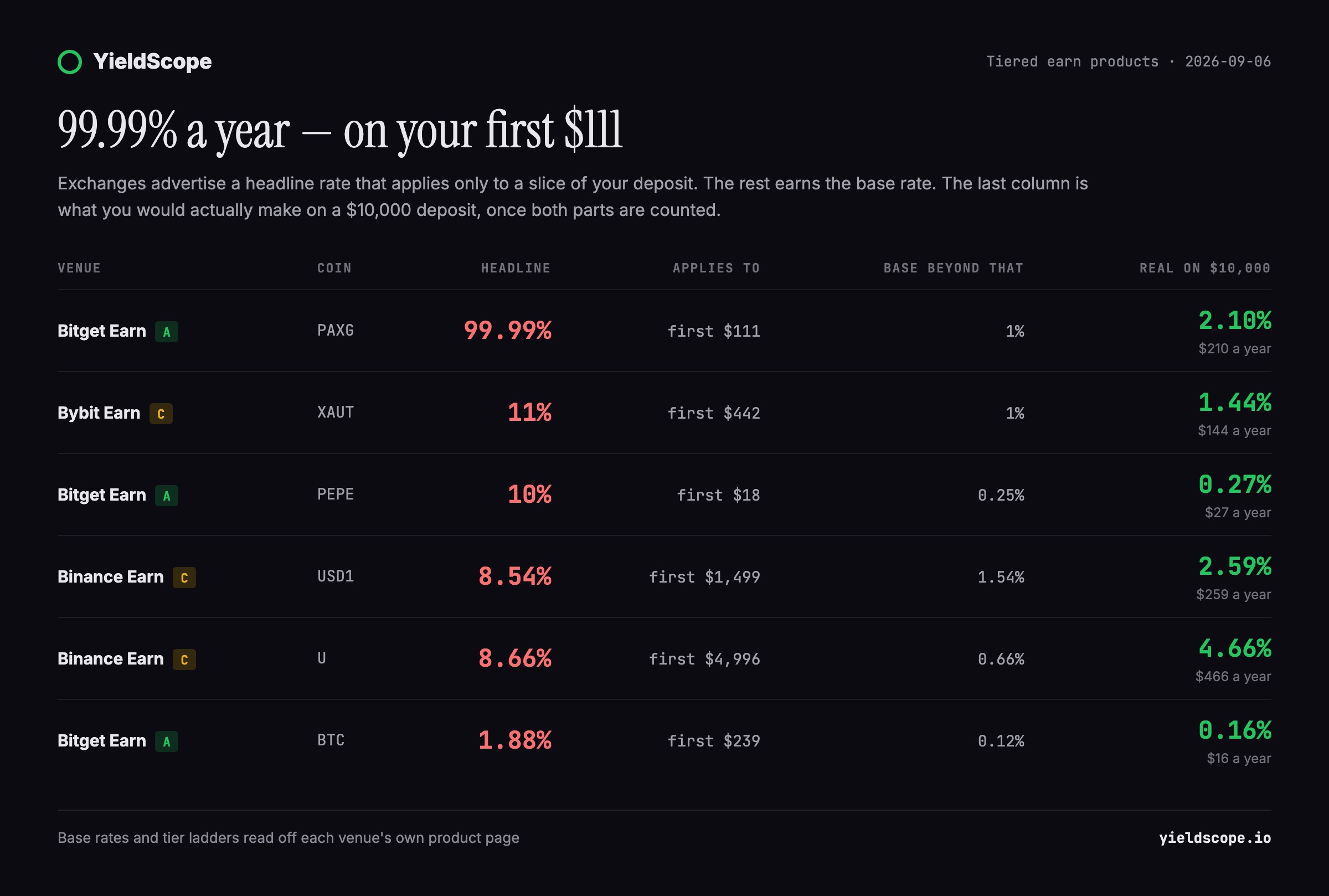
Bitget advertises 99.99% a year on PAXG, the gold-backed token. That rate applies to your first 0.025 PAXG — about $111 at the current gold price. Everything beyond earns 1%.
Put $10,000 in and the arithmetic is unforgiving: $111 earning 99.99% produces about $111 over a year, and the remaining $9,889 at 1% produces $99. Total: roughly $210, or 2.10% on the whole deposit.
The same structure, elsewhere:
- Bitget PEPE — headline 10%, applies to your first $18, base 0.25% beyond. On $10,000 that works out to 0.27%.
- Bybit XAUT — headline 11%, applies to your first $442, base 1% beyond. Real result: 1.44%.
- Binance USD1 — headline 8.54%, applies to your first $1,499, base 1.54% beyond. Real result: 2.59%.
- Binance U — headline 8.66%, applies to your first $4,996, base 0.66% beyond. Real result: 4.66%.
The last one is the interesting case. Binance's quota is large enough that half your deposit earns the promoted rate, so 8.66% becomes 4.66% rather than collapsing to near-base. Quota size, not headline size, decides what you actually earn.
Note the safety grades in that table, too. Bitget passes all five of our safety checks and carries an A. The tiered-teaser mechanic is not a marker of a dangerous venue — reputable exchanges use it as routinely as reputable banks do.
The extreme case: a headline over nothing
Crypto.com currently publishes ceilings of "up to 1.5%" on BTC and "up to 1%" on ETH for flexible allocations. Their own calculator, run for USDC across every membership tier, returns 0.00%.
The flexible rate is zero. Any non-zero number requires a paid membership plan starting at $6.99 a month plus a fixed term. We therefore publish no products at all for that venue — a zero is not a rate worth listing, and a ceiling is not a rate at all.
How to read a rate in ten seconds
Whether it is a bank or an exchange, three questions strip a headline down to what it is worth:
- What do I get for doing nothing? If the page does not say, the answer is usually much lower than the headline. Look for the words "up to", "as high as", "with qualifying activities".
- How much of my money does the headline cover? A rate that applies to the first $111 is a rounding error on a real deposit. A rate that applies to your first $100,000 is a genuine offer.
- How long does it last? Introductory rates for the first two to four months are the most common form of the gap. Ask what the rate becomes in month five.
If the answer to any of these is not on the page you are reading, it is on another page of the same site — and the venue chose which page you would land on.
Our own rule
We publish base rates. When a venue offers a tier ladder, we record the ladder alongside the base so a calculator can re-price it for whatever amount you actually hold, but the number we lead with is what an ordinary deposit earns.
We do not publish zeros, and we do not publish ceilings as if they were rates. Every figure comes from the venue's or the bank's own page, never from a rate aggregator — aggregators systematically show the top tier, because a bigger number converts better.
You can see every bank we track, with all three numbers, on the banks page, and every crypto venue with its safety grade on the safest platforms ranking.
Rates are floating and were checked on the date shown in each chart. Not financial advice.
Educational content, not financial or legal advice. Sources are linked in the text.