Yield
YieldFrom 0.60% to 32.75%: where money can sit right now, and what each step costs you
We measured 78 banks in 19 countries, around 40 crypto venues and 562 DeFi pools with one fixed rule. On 1 September 2026 a safe dollar pays about 4.00% and the highest state-insured rate anywhere is 32.75% — in Turkish lira. Here is the whole ladder and the price of every rung.
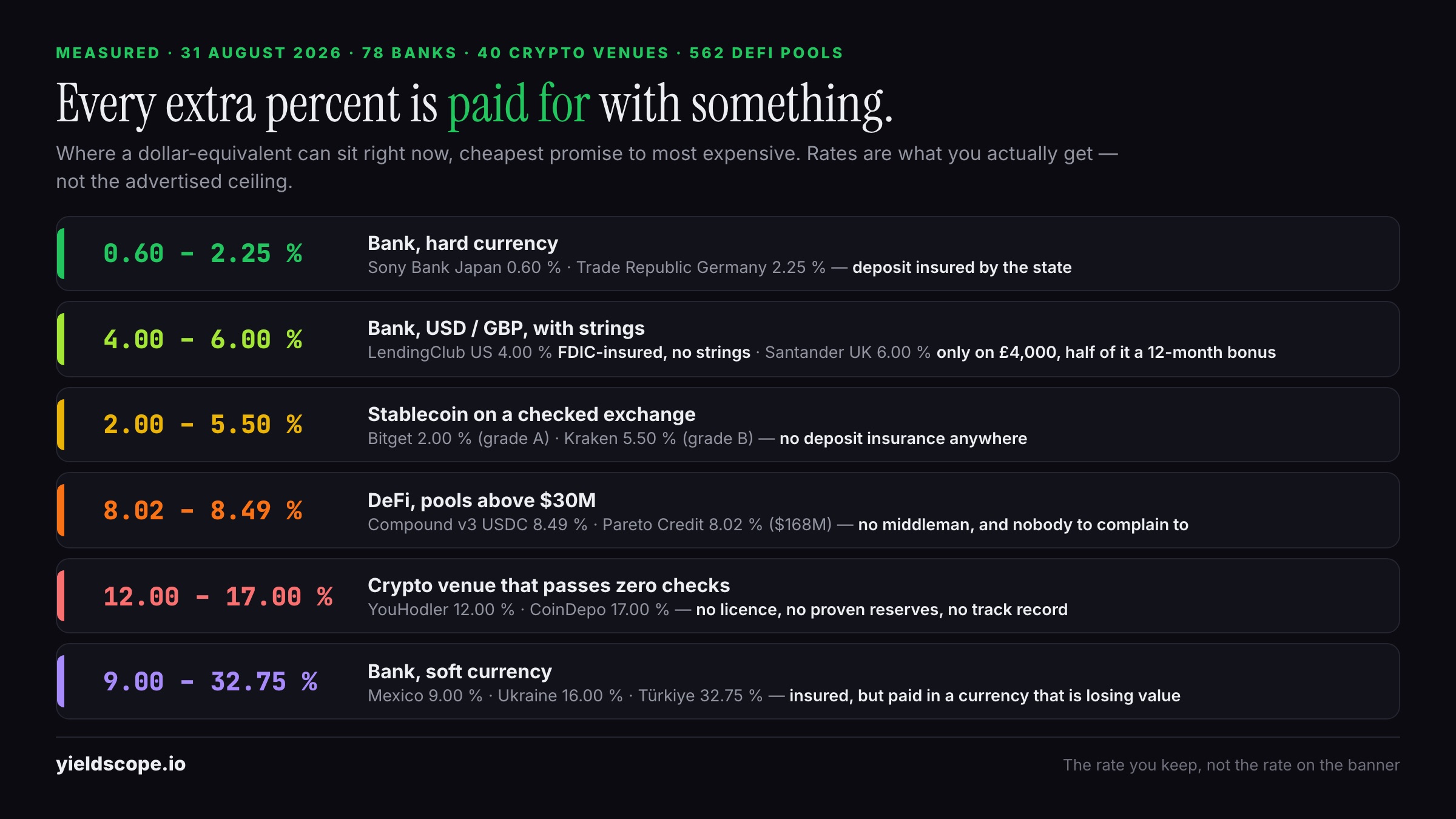
On 1 September 2026, the best flexible rate on a US dollar at an insured American bank is 4.00% (LendingClub). The best flexible rate on a dollar stablecoin at a venue passing 4 of our 5 safety checks is 5.50% (USDT on Kraken Earn). The highest state-insured savings rate anywhere in our data is 32.75% (DenizBank, Türkiye) — paid in lira. Every number in between is explained by one rule: each extra percent is paid for with something.
There is a specific kind of confusion that hits anyone trying to answer a simple question — where should I keep money I am not spending this year?
One bank offers 0.60%. Another, in a different country, offers 32.75%. A crypto exchange says 5.50%. A DeFi pool says 8.49%. A platform you have never heard of says 17.00%. All of these numbers are real, all are current, and none of them mean the same thing.
For the past month we wrote all of them down. Every day, the same fields: what does this place pay, on what terms, and what happens to your money if it goes wrong. Seventy-eight banks across nineteen countries. Around forty crypto venues. Five hundred and sixty-two DeFi pools.
The number we publish, and why it differs from the banner
For every product we record three things: the base rate (what you get doing nothing), the realistic rate (what you get under ordinary behaviour), and the headline rate (the marketing ceiling). Everything below is the realistic rate.
That distinction is not pedantry. Santander UK advertises 6.00%. The realistic rate is also 6.00% — but only on the first £4,000, only if you hold their current account, and 2.5 of those six points are a bonus that expires after twelve months. Ubank in Australia advertises 5.85%; that includes a 0.75-point welcome bump for new customers lasting four months, after which you are on 5.10%.
Neither is a lie. Both are in the terms. But the advertised number and the number that reaches your account are different quantities, and only one is worth comparing across venues.
1. The floor: a bank in a hard currency
- Sony Bank, Japan — 0.60%
- Trade Republic, Germany — 2.25%
- Marcus by Goldman Sachs, USA — 3.40%
- LendingClub, USA — 4.00%
This is the dullest row in the table and the most important one, because it is the reference price. In all four cases a government insurance scheme stands behind the deposit — in the US, $250,000 per depositor per bank. Nothing else in this article has that.
Treat 4.00% as the price of a safe dollar, and read every higher number as a question: what am I giving up for the difference?
2. The same $10,000, four wrappers
Take ten thousand dollars and leave it somewhere for a year:
- LendingClub, a US bank — $400 — federally insured
- Kraken, USDT — $550 — regulated exchange, no deposit insurance: if it fails you are an unsecured creditor
- Compound v3, USDC — $849 — no company at all, just a contract that either works or doesn't
- CoinDepo — $1,700 — passes zero of our five safety checks
Laid out like that, it stops looking like four investment options and starts looking like what it is: four different answers to one question — who owes you this money, and what can you actually do if they don't pay it back?
The dollar figure rises in exact proportion to how bad that answer gets. That is not an inefficiency waiting to be arbitraged. It is the market pricing risk, doing its job.
3. Where you keep it matters more than what you keep
Here is the finding that surprised us most.
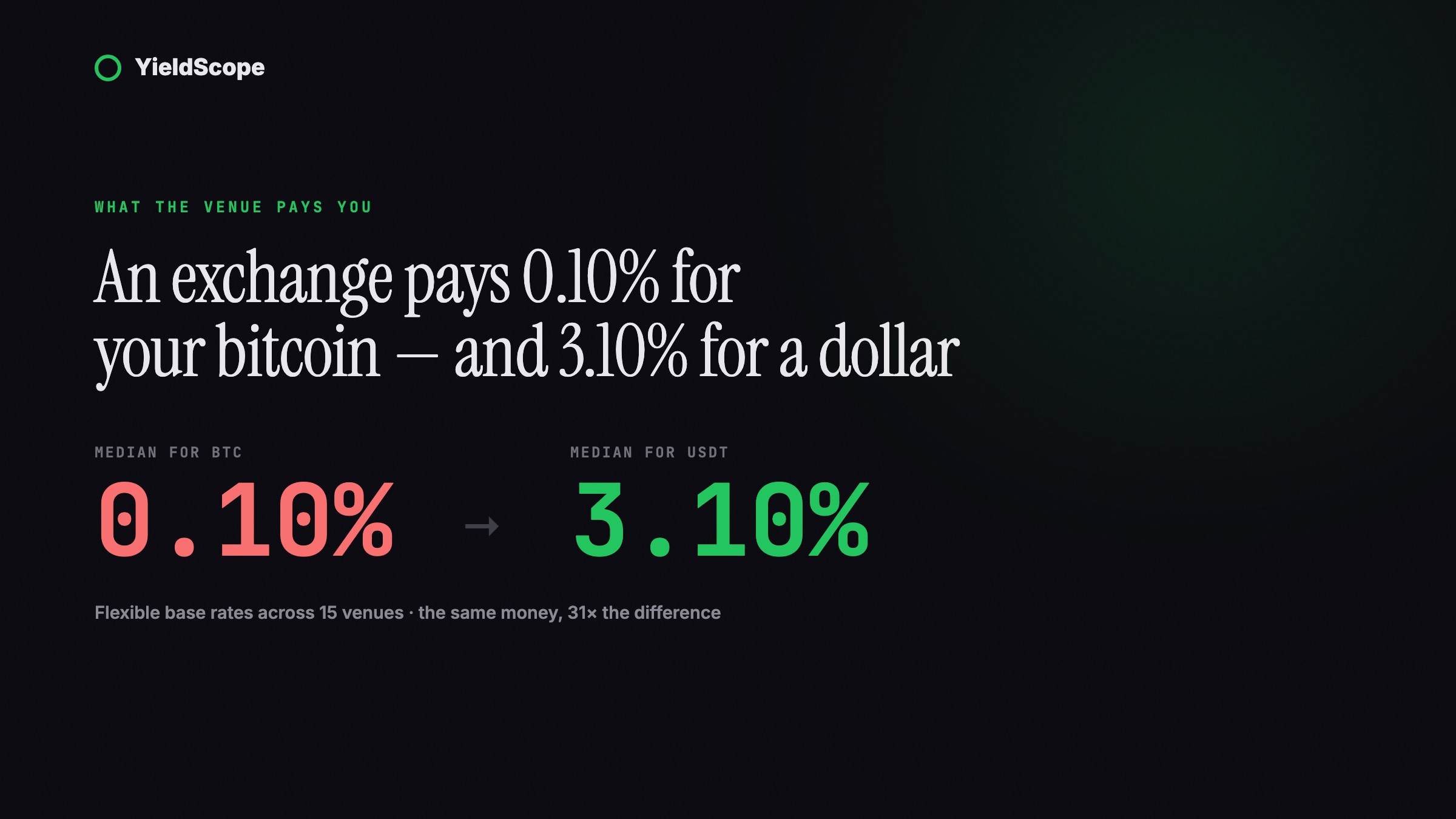
USDT is meant to be the least interesting asset in existence: one dollar, everywhere, always. Yet the rate for lending that same dollar out, on flexible terms, ranges from 0.95% to 17.00% depending only on which venue holds it. Fourteen venues, sixteen points of spread.
Sixteen points on a stablecoin is a wider gap than you will find between most asset classes. People spend enormous energy choosing which coin to hold. The data says the venue decides more than the coin does.
And — this is the part worth sitting with — our safety grade does not sort that list.
Five venues in our table share the identical grade B, meaning each passes four of our five checks. On the same $10,000 they pay $100, $194, $251, $350 and $550 a year. Five and a half times apart, at identical safety.
Meanwhile the one venue in the set with a perfect five-of-five score, Bitget, pays 2.00% — below several riskier neighbours. On Bitcoin, the other perfect-score venue pays 0.02%. That is two dollars a year on ten thousand.
So there is no premium for choosing the safe option. If anything there is a mild penalty. Safety and yield are independent questions, and a comparison answering only one of them lets you feel informed while missing half the trade. Our platform grades spell out which five checks each venue passes.
4. The highest insured rate in the world, and why it is not what it looks like
The highest state-insured rate anywhere in our data is DenizBank in Türkiye: 32.75%. It is completely real. The deposit is insured. There is no catch in the paperwork.
It is paid in lira.
A high rate in a soft currency is not a better deal than a low rate in a hard one — it is the price the bank must pay you to hold that currency instead of something else. The correct comparison for 32.75% in lira is Turkish inflation and the exchange rate over your holding period, never a dollar rate. The same logic covers Ukraine at 16.00% and Mexico at 9.00%. Country-by-country figures are on our bank rates pages.
5. What a rate that isn't a price looks like
CoinDepo pays 17.00% on flexible USDT — the highest number in our entire crypto set. It passes zero of our five checks: no licence, no proof of reserves, no insurance fund, no verifiable operating history. It is registered in Panama.
But the detail we find more telling than any of those: across 27 coins and 32 daily readings this month, not a single one of its rates changed. Not on stablecoins, not on Bitcoin, not on any day.
Compare that to a rate that is genuinely a price. OKX changed its USDC rate on nine separate days this month:
2.50 → 2.67 → 2.80 → 2.83 → 3.12 → 2.80 → 3.02 → 3.00 → 3.18 → 3.50
That is what borrowing demand looks like from the outside. It drifts, backs up, drifts again, because somewhere real people are borrowing real dollars at a price that changes.
A figure that responds to nothing — not to rate moves, not to market stress, not across twenty-seven different assets — was not produced by a lending market. It was set by a decision. And a decision can be un-decided the day it stops being convenient.
We do not have CoinDepo's books and will not pretend we know what is inside that 17%. We are pointing at a property of the number itself, which anyone can verify by writing it down daily for a month.
6. DeFi, and the trap of reading one day
Today Compound v3 pays 8.49% on USDC. Its thirty-day average is 4.08%.
Both figures are true. Only one describes what a year would plausibly look like. DeFi rates move with borrowing demand hour by hour, so a single-day screenshot — which is what almost every "best DeFi yields" listicle is built from — is close to meaningless.
The steadier comparison in the same data is Pareto Credit: 8.02% today, 8.04% as a thirty-day average, in a pool holding $168 million. That is a number you can plan around. Compound's is a number you happened to catch on a good day. Both sit in our DeFi pool table with their averages next to them.
And at the top of the DeFi range sits something else entirely. Uniswap v3's WETH-USDC pool on Base shows 95.57% APY on $114 million of liquidity. That is real too — and it is not a deposit. Providing liquidity to a volatile pair exposes you to impermanent loss: when ETH moves sharply either way, the pool rebalances you into the side that lost, and fee income has to cover that before you are ahead of simply holding.
It is a job, not a savings account. The APY is your wage for doing it, and like any wage it can be less than the work costs you.
7. The flattest corner of the market
One last observation, because it says a lot in very few numbers.
Six of the fifteen largest cryptocurrencies — XRP, ADA, DOGE, DOT, LINK and LTC — all pay exactly 1.00%. The same figure a month ago, the same figure today, at the same venue.
Six different networks, six different stories, one identical number. When a desk prices risk you see decimals: 3.31%, 8.49%, 16.54%. A clean 1.00% repeated six times is not a price at all — it is a house default, the small safe number a venue can pay on anything without thinking about it.
Which puts the whole ladder in perspective. A plain dollar at an American bank pays 4.00%. Six of the biggest coins in the world pay 1.00%. For most of the market, lending your coins out is simply not a business anyone competes for.
How to use any of this
Five questions, in the order we would ask them:
- What does a safe version of this currency pay right now? That is your floor. In dollars today it is about 4%.
- What exactly am I being paid extra for? Currency risk, a lock-up, a missing licence, a paid subscription, or the right to complain to a regulator. It is always one of those, and always something.
- Is this the rate or the ceiling? Look for "up to", "first £4,000", "new customers", "with a paid plan". The qualifier is where the difference lives.
- In DeFi, what is the thirty-day average? Not today's number.
- Has this rate moved in the last month? If it has not moved at all, on anything, ask what it is made of. Prices move. Brochures don't.
None of that tells you what to do with your money. It tells you what you are being offered, which is the part most comparison tables leave out.
Every bank, venue and pool above — with the five safety checks itemised per venue and full rate history — is in our measurements.
Not financial advice. All rates are variable snapshots taken on the dates shown and can change without notice. A high yield is compensation for risk; the risk does not disappear because the number is attractive.
Educational content, not financial or legal advice. Sources are linked in the text.